Why apparel and gift stores lose the sale
Nobody needs another mug or another t-shirt. People buy the message on it, or the moment it's for, and most stores strip that away the moment shopping starts.
- Different products share one catalogue. A t-shirt, a mug and a framed print are three different purchases. Lumped together, none of them get found.
- The brand voice disappears. The homepage says something, then the collections turn into a grid of thumbnails and prices.
- Mobile layouts create friction. Gift shopping often happens on a phone on the sofa, and a clumsy layout ends it early.
- Browsers drop out before checkout. Every extra tap between a product and the cart costs orders.
- Gift buyers and self-buyers want different things. One shops by occasion or recipient, the other by style and size, and a flat catalogue serves neither.
What I build for apparel and gift brands
- A store with a clear door for each product type. AI Shopify store development starts from $1,500 for up to 20 products. The Growth package, from $2,750, covers up to 100 products with custom collection architecture, a cart drawer, cross-sells and bundles, and abandoned-cart and post-purchase flows.
- Campaigns for launches and gifting seasons. AI digital marketing from $700 a month covers a paid channel, a landing page per campaign, social posts and email to your list. The Grow package adds retargeting. You pay ad spend directly, and I charge a flat fee rather than a percentage.
- Search for every category. AI SEO services from $600 a month optimize collection and product pages with Product markup, so each category can be found on its own terms on Google and in AI answers.
Product descriptions are generated with AI from a controlled dataset and held to your brand voice, so the tone of the homepage carries through to the hundredth product page.
Proof: a recent apparel and gift store
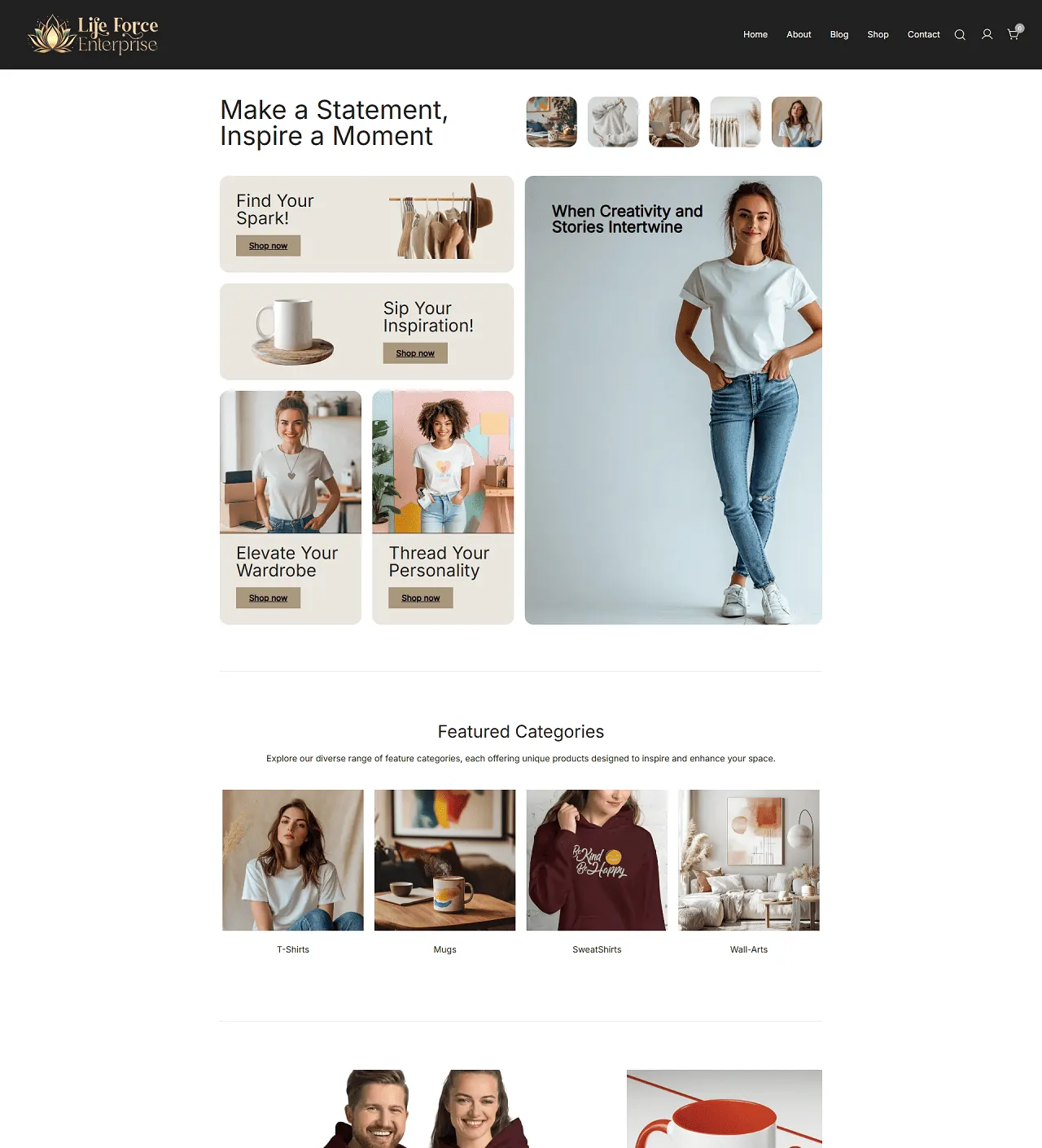
Life Force Enterprise sells motivational apparel, drinkware, wall art and gifts, products people buy for the words on them. Before the rebuild, the four product types had no clear categories and the brand message vanished once shopping began.
The rebuilt Shopify store gives apparel, drinkware, wall art and gifts their own sections, so a shopper who came for a mug isn't wading through t-shirts. The brand voice is carried into collections and product pages, and filtering, sorting and quick add-to-cart shorten the path to checkout. Reviews and newsletter capture are built in.
The whole store was rebuilt mobile-first on Shopify's native stack with a customised theme, with no page-builder app slowing it down. It was built in one week at a fixed $2,600.
How a store project runs
- Discovery. Your products, your buyers, your competitors and where sales are being lost today.
- Strategy. Store structure, collections and automation, set out in a written proposal with a fixed price and an exact launch date.
- Build. The store, catalogue, cart and flows, including a full redirect map if you are moving from another platform.
- Launch. Testing, performance tuning and a handoff with documentation, recorded walkthroughs and training.
Most stores go live in 3 to 7 days, and the price never changes mid-project.
You work with me directly. I've shipped 1,400+ projects since 2014 for clients in 40+ countries. Book a free 30-minute call, tell me what you sell, and I'll tell you what I would change first and roughly what it would cost.