Why food brands struggle to sell online
A food brand sells something a screen can't taste. The shopper has to trust who made it, how and from what, before anything goes in the basket.
- Provenance gets lost. The founder's story and the recipe's origin sit on an About page, while the shop shows a grid of jars.
- Doubt arrives by default. An unusual product, or a cuisine made far from where it comes from, has to prove it's the real thing.
- Small batches sell out. Without filtering by availability, shoppers click into products they can't buy.
- Products and experiences collide. Brands that also run workshops, tastings or classes end up with one menu that serves neither buyer.
- What isn't in it goes unsaid. No sugar, no preservatives, no fillers: these are selling points, and they need saying clearly.
- Baskets stay small. Without bundles or a free shipping threshold, most orders are a single item.
What I build for food brands
- A Shopify store that leads with provenance. AI Shopify store development starts from $1,500 for up to 20 products. The Growth package, from $2,750, adds collection architecture, a cart drawer, bundles and abandoned-cart and post-purchase flows. Collections, filtering by availability and price, and workshop or class booking can all live in the same store.
- Ads, social and email for a product people want to see. AI digital marketing from $700 a month covers a paid channel, a landing page per campaign, social posts built from your real work and email to the list you already have. You pay ad spend directly, and I charge a flat fee.
- Search for what people look up before they buy. AI SEO services from $600 a month cover Product markup, content that answers ingredient and sourcing questions, and AI search optimization so assistants can quote your pages.
If you would rather run everything on WordPress with full control of the code, a WooCommerce store through AI WordPress website development is the alternative.
Proof: a recent food brand store
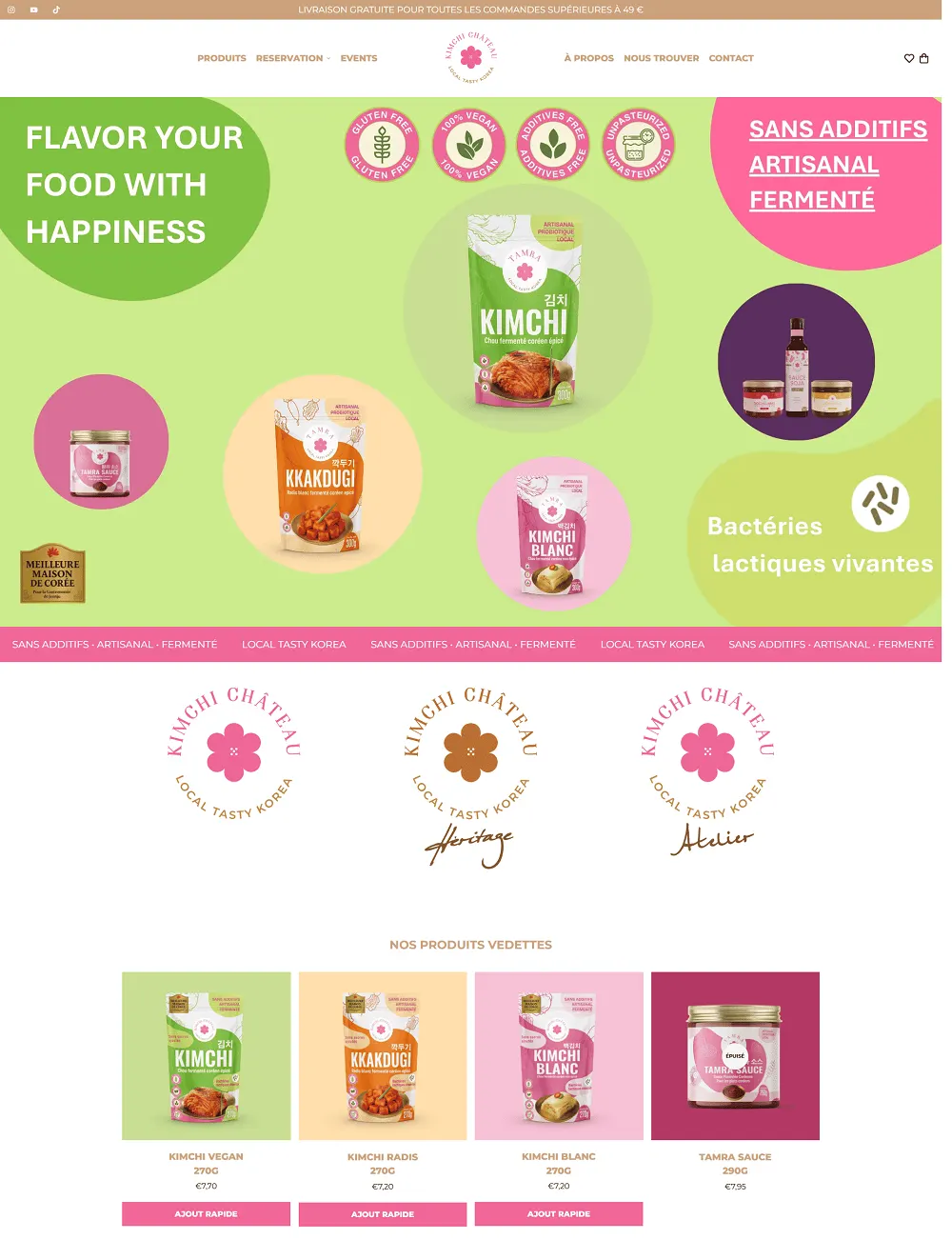
Kimchi Château is run by Honglim Yu, a Master Artisan of Korean cuisine, Burgundy's ambassador for Korean gastronomy and the fourth generation of her family to ferment. She makes kimchi at Château de Devay, on 25 hectares in rural France.
The Shopify store states that provenance before the first product, so Korean food made in France reads as rare rather than odd. Nine products sit in two collections, Château and Héritage, with filtering by availability and price because small artisan batches sell out.
Jars and château workshops each get their own route from the same homepage. Ten workshop formats, from Kimchi to the Kimjang Masterclass, book through Koalendar with no email exchange, and a €49 free shipping threshold nudges basket size. The store was built in one week at a fixed $2,000.
How a food brand project runs
- Discovery. Your products, your buyers, your competitors and where sales are being lost today.
- Strategy. Store structure, collections, booking and automation, set out in a written proposal with a fixed price and an exact launch date.
- Build. The store, catalogue, cart and any booking integration, including a full redirect map if you are moving from another platform.
- Launch. Testing, performance tuning and a handoff with documentation, recorded walkthroughs and training.
Most stores go live in 3 to 7 days. Larger builds with subscriptions, several languages or CRM integration take two to three weeks, and the proposal tells you exactly how long.
You work with me directly. I've shipped 1,400+ projects since 2014 for clients in 40+ countries. Book a free 30-minute call, tell me what you make and how you sell it today, and I'll tell you what I would change first.